



I don’t know about you, but when I saw that first trailer for The Mandalorian and Grogu, my only thought was “Holy shit, was that Martin Scorsese???” and it was, reader. It was Martin Scorsese. In honor of that, and the fact that I, like my beloved colleague Emmet, mostly enjoyed the Baby Yoda movie, I am going to rank Mr. Scorsese’s acting roles from “Worst” to “Best”—but come on, they’re all good.
I’m not including his cameos in his own films, although I can’t go any further in this post without singing the praises of his scene in Taxi Driver, or the extraordinary meta roles he plays in Mean Streets (he becomes senseless violence itself!) and Killers of the Flower Moon (his appearance serves as commentary on mediation and how our culture slices and dices real human tragedy for entertainment!)—but I’m not here to talk about that! This is a lighthearted list post! I will also mostly avoid talking about roles where he plays a version of himself, or roles that are just glorified cameos—I’ve stuck to the times where he gets the opportunity to play a real character.
I noticed an interesting throughline here—most of his characters, no matter how small, exist in a tension between lies and truth. A recurring theme is whether his character will “talk”: give information that might save the innocent, but endanger himself, rat innocent people out for his own gain, sell any sense of decency or truth out for money. It’s clear that a lot of directors want to use the metafictional weight of Scorsese’s career as a kind of shorthand. But again, that’s most of them—there’s one big, glorious exception, as you’ll see.
The Accountant — Search and Destroy

Scorsese is only in one scene in Search and Destroy, the kind of late ‘80s/early ‘90s indie movie that seemed to spawn spontaneously on the shelves of Blockbuster, wacky cover and Christopher Walken performance already in place. This film is not good! But the actors are game, and Scorsese’ cameo as an exhausted IRS agent is one of the highlights.
Goodley — ‘Round Midnight

In Bernard Tavernier’s ‘Round Midnight, Martin Scorsese plays Goodley, a club owner and booker for troubled jazz genius Dale Turner (tenor saxophonist Dexter Gordon). The whole movie is about various people desperately trying to get Dale to lay off the booze and take care of himself so his true jazz genius can flower, and for a while, at least, it works. Scorsese’s character is a bit morally grey—unlike some of Dale’s other colleagues, he’s obviously using the musician to get people in his club. He books him into the same seedy hotel he used to stay at, where the same drug dealer lurks in the halls. He also seems actively hostile to Dale’s friend Francis, a French jazz fan who kind of inadvertently becomes Dale’s life support system. Scorsese has one great motor-mouthed scene yammering about how New York is better than Paris as the three men share a cab over the Brooklyn Bridge, and man is it great, but but that’s really his meatiest scene. Aside from that, a thing I love and have to mention is that John Berry, the real-life blacklisted director who inspired a movie further up this list, plays a Parisian club owner named Ben. Also Herbie Hancock won an Oscar for the score, and it’s fucking fantastic.
Martin Scorsese — The Studio

OK, Martin Scorsese does play a version of himself in the pilot episode of Seth Rogen’s excellent Apple TV series (it’s a stealth sequel to The Player! I love it so much!) but I decided to include it anyway because first, Scorsese’s breathless explanation of his Jim Jones cult movie is hysterical, second, his sobbing breakdown when Seth Rogen’s Matt Remick cancels his movie is somehow even more hysterical, and third, it’s my list, and I do whatever I want.
Sykes — Shark Tale

I am not the demographic for Shark Tale. (TBH, I’m not sure what that demo would even be??? But I know I’m not it.) Scorsese plays Sykes, a puffer fish who runs a whale wash—you know, a car wash, but for whales—and pays protection money to Don Lino, the Great White head of the shark mafia, who is inevitably voiced by Robert De Niro. The shark uses the whale wash as a front for his criminal empire, a thing that absolutely belongs in a children’s film. (TBF, the scenes of Scorsese and De Niro riffing and talking over each other are the best in the movie.) But Scorsese’s role is a bit muddled: Sykes has a pair of Rastafarian jellyfish henchmen whom he absolutely employs to torture people who cross him in this ostensible children’s film, but also a school of baby fish regularly torment him to make him puff up for fun? And fear no form of retribution? Baffling! Once Will Smith’s character, Oscar, becomes famous, Sykes appoints himself Oscar’s manager, and immediately morphs into a dorky older guy who wants to seem cool. Also baffling! But whatever, Scorsese does a great job with Sykes’ fish-mafia-related panic attacks, and gets to say things like “Raise the reef!” and sing “Mack the Knife” with new lyrics about his client, whom, according to Wikipedia, is a bluestreak cleaner wrasse, murdering the don of the shark mafia.
This movie makes me wish I’d had kids.
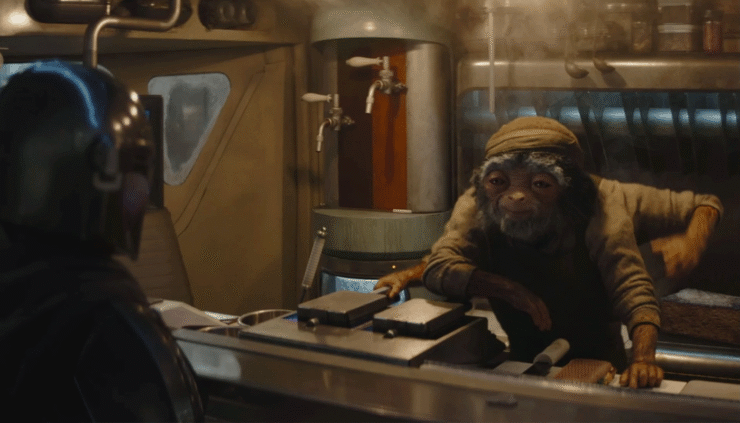
Hugo Durant — The Mandalorian and Grogu

Motion Pictures
Scorsese has two scenes in Mandalorian and Grogu. He plays Hugo Durant, a four-armed Ardennian who runs a cute little food truck that looks like an intergalactic Airstream trailer. This role riffs on Scorsese’s prior work in an amusing way—once again, he’s a small time guy in a big city. Once again, he’s entangled in organized crime, and pays Janu Coin protection money so his food cart can survive. And once again, he’s desperate not to talk or implicate himself in any way… but the words seem to spill out against his will, the usual high speed old school Lower East Side chatter that simultaneously says too much and nothing at all. Scorsese brings a lot of vibrancy to a character that could have been one note, and I really wish they’d brought him back for more.
Vincent Van Gogh — “Crows”, Akira Kurosawa’s Dreams

Martin Scorsese plays Vincent Van Gogh in a film by Akira Kurosawa.
Every once in a while this stupid universe makes sense.
Apparently Kurosawa thought that only Scorsese could capture the frenetic energy and drive of Van Gogh for his film Dreams, a series of vignettes based on actual dreams the director had. In “Crows”, a Japanese painter visits a Van Gogh exhibit, finds himself in the paintings, and finally speaks with Van Gogh himself. While he approaches the master with reverence, Van Gogh simply glances at the man and barks “Why aren’t you painting?” Scorsese is great, specifically because he’s so startling in the role—his classic fast-talking schtick is now used in service of an artist who knows it’s life or death to capture light and life, as quickly as he can, never quickly enough, to celebrate the world around him whether anyone else understands his vision or not.
There’s some hilarious BTS footage where Scorsese explains that he worked to memorize his lines for Dreams as he rushed to finish Goodfellas, which had gone a few days over schedule, which seems somehow the most fitting way to prep for this role. And as if that wasn’t enough ,the bullet train ride to the set afforded Scorsese the time to read Shusaku Endo’s Silence, which percolated in the director’s mind for 30 years before he finally made his adaptation.
When it’s my turn to run this universe, every sentient being will start their day with this clip like it’s scalding black coffee from a chipped diner mug, and we’ll see how things go from there.
Joe Lesser — Guilty by Suspicion
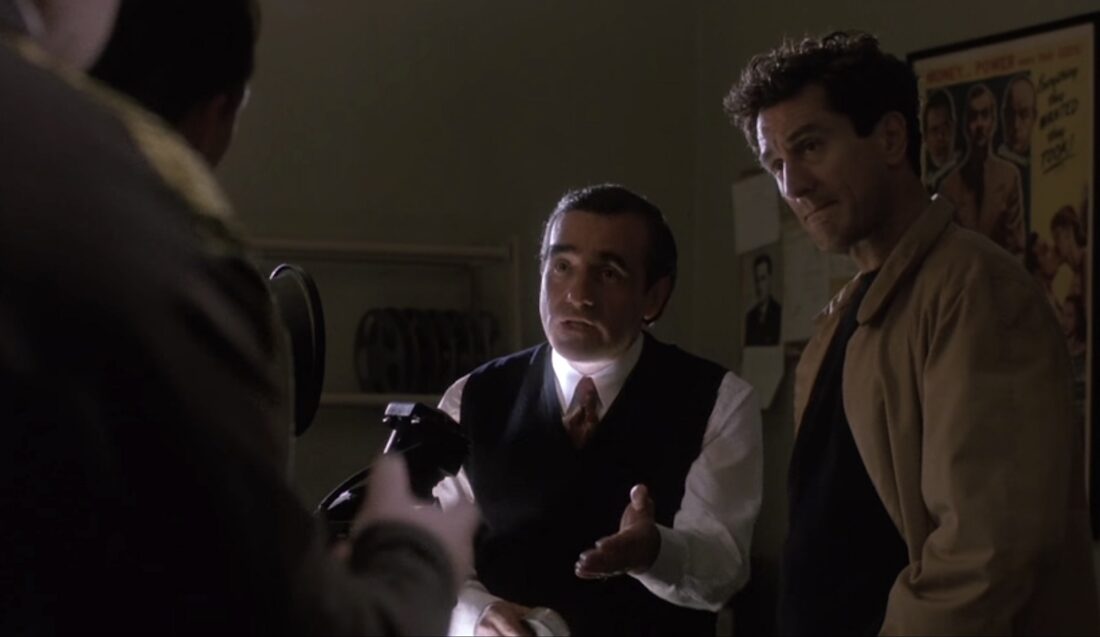
The only reason I knew about the House Un-american Activities Committee—or as I prefer to call them, fucking xenophobic traitors to the principles of the United States of America—was because Lauren Bacall talked about it at length in her autobiography, By Myself which I read when I was 11. (I then waited, and waited and waited, for this horrifying chapter of U.S. history to come up in school. LOL.) But for some reason I never got around to this film that’s directly about HUAC and its evils until I was researching this list. While the movie is a little stiff at times, it comes at the issue from what I think is a perfect angle: the accused Communists are people who felt they could change the system when they were young, but now, hitting middle age with careers, kids, and mortgages in tow, they know their lives can be destroyed in one afternoon. The thing they’re all really, really afraid of is that they might crack under questioning and turn out to be the kind of people who name names. Spoiler alert, a lot of them are.
To condense the horrors of the blacklist into one film-length story, the screenwriter, Irwin Winkler, creates composite characters who are then mixed in with real people like Darryl F. Zanuck, Howard Hawks, and Humphrey Bogart, and uses his composites to show four different paths that a lot of real people took: rat, and be rewarded by society; refuse to name names, and try to cobble an existence together under terrible circumstances; crack under the pressure and kill yourself; leave the country.
Robert De Niro plays David Merrill, a man who takes the second path (largely based on director John Berry, who left the U.S. for Paris after an attempt to fight the blacklist). Martin Scorsese plays Joe Lesser, whom I’m guessing was based more on Jules Dassin or John Huston, and takes the last path almost immediately. Where Dassin moved to Paris and Huston to Ireland, Joe’s one lengthy scene opens with the announcement that he’s already been dodging a subpoena for two days, and he leaves for London in five hours.
This is one of Scorsese’s most assured performances. Maybe because he’s comfortable playing a Golden Age director, he’s completely natural and off-the-cuff, and doesn’t resort to any of the schtickiness that some of his performances have. His scene is almost ebullient—when his editor, Mike, tries to mollify him and say he has nothing to worry about from the committee, he bark-laughs this response:
Joe: “Mike, I’m a Communist! I was a Communist 20 years ago and I’m a Communist now!”
Joe’s producer: “I don’t want to hear that!”
Joe: “Well you’ve heard it!”
Producer (to the editor): “I didn’t hear anything! Did you hear anything?”
Editor (to Joe, seriously and admiringly): “I didn’t hear anything.”
After the producer and editor leave, David also tries to convince Joe to stay in the U.S., but his reply is breezy—and obviously meant to hide a well of anger and frustration: “I’d have to stay out of rooms with mirrors for the rest of my life—but I like looking at myself too much.”
Martin Rittenhome — Quiz Show
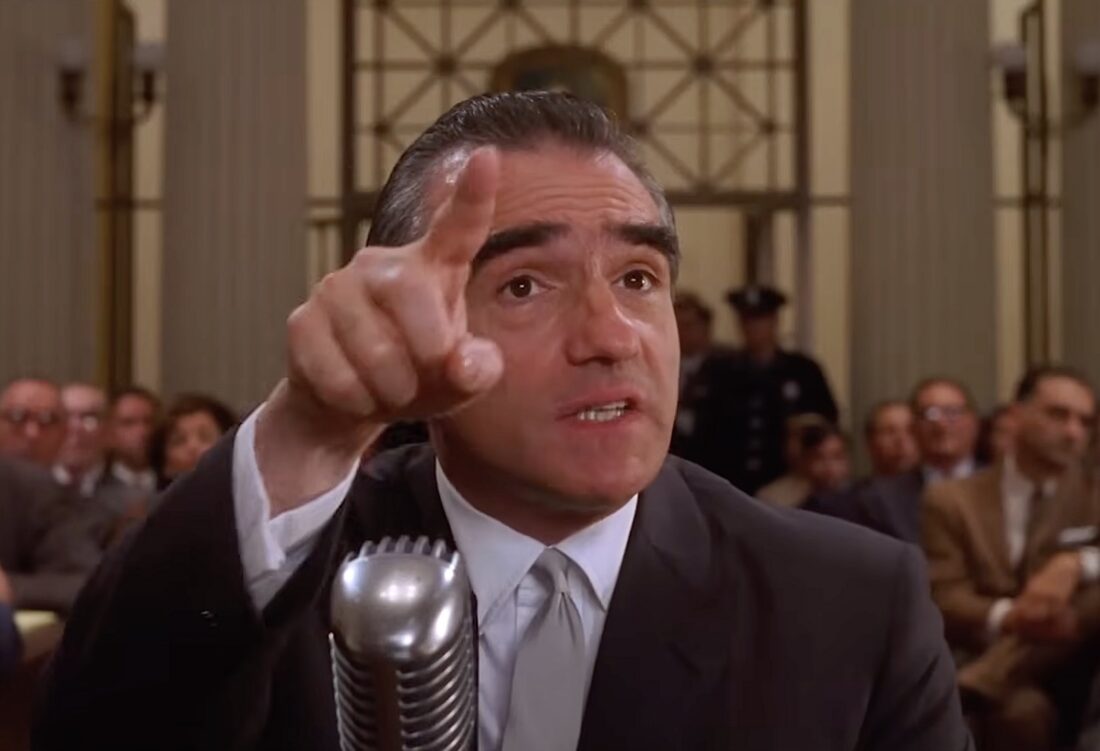
Scorsese plays Geritol exec Martin Rittenhome in another movie about Mid-Century corruption, classism, and anti-Semitism, with a healthy callback to the HUAC hearings thanks to the use of On the Waterfront as a plot point.
Again, his role is used to rip the curtain back on corruption. Again, he’s called to testify before his fellow men, he supposed to tell the truth, he’s supposed to uphold a sense of honor. And again, in public says a lot without saying anything, while in a private meeting with Rob Morrow’s Richard Goodwin he cheerfully informs the younger man that Americans “just wanted to watch the money”, and had no interest in the intellectual aspects of a quiz. Public opinion moves fast.
This one ranks this high because he loses himself in the character. He’s not his motor-mouthed caricature—just a terrifying businessman who knows there are no consequences to face.